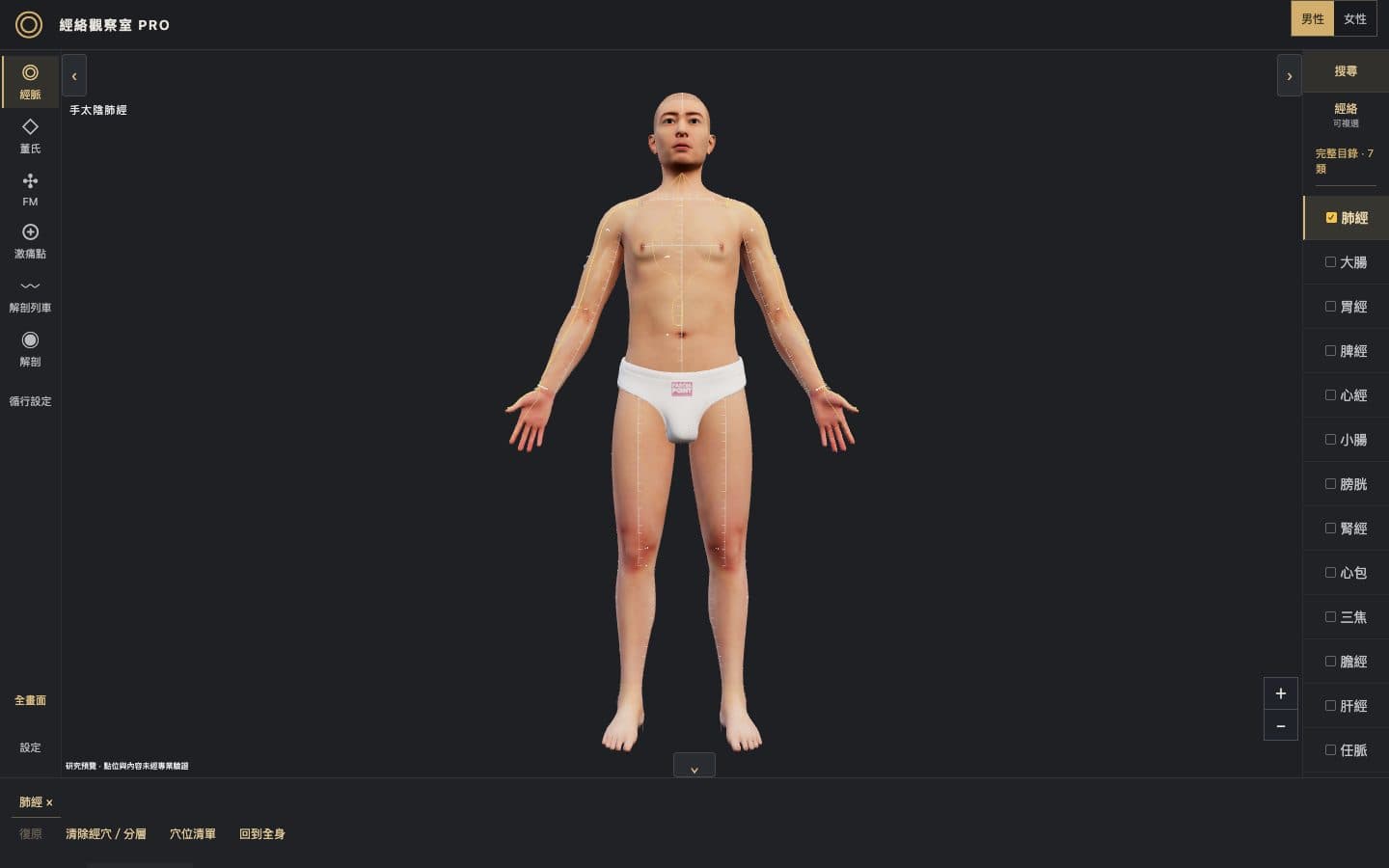
Meridians and points
Overlay one or more meridians, search point names, open point details, and filter by point category, five phases and pairings.
MERIDIAN OBSERVATORY · 3D BODY
Explore meridians, acupoints and anatomical layers on a 3D body — start from a place on the body and compare muscles, referred pain and fascial lines.
You don't need to know the name of a muscle or a point first. Tap a region, narrow it down step by step, and the related meridians, muscles, fascial lines and referred-pain sketches appear on the same body.
PRO is best on desktop and tablet; on a phone, start with Lite.
Research preview · points and content are not professionally verified · viewer interface is in Chinese
Meridians and Tung's extraordinary points are an Eastern map of the body; Anatomy Trains, FM points and trigger points are Western views of fascia and muscle. The Observatory places them on the same 3D body and the same coordinates, so you can select, rotate and compare them together — which is what sets it apart from a meridian chart or an anatomy app.
East
West
Sharing one set of body coordinates does not make meridians, fascial lines and referred pain equivalent in theory or clinical meaning. The Observatory compares positions; it does not diagnose or prescribe.
01
Pick a place on the 3D body or start from the main regions: head and neck, shoulders and back, chest and abdomen, pelvis, limbs.
02
Choose a sub-region or a pain location. Only the related content stays on screen — the whole body is never covered in markers at once.
03
Related muscles, meridians and points, fascial lines and referred-pain sketches unfold one by one. You can always return to the whole body, switch region or clear the selection.
Overlay one or more meridians, search point names, open point details, and filter by point category, five phases and pairings.
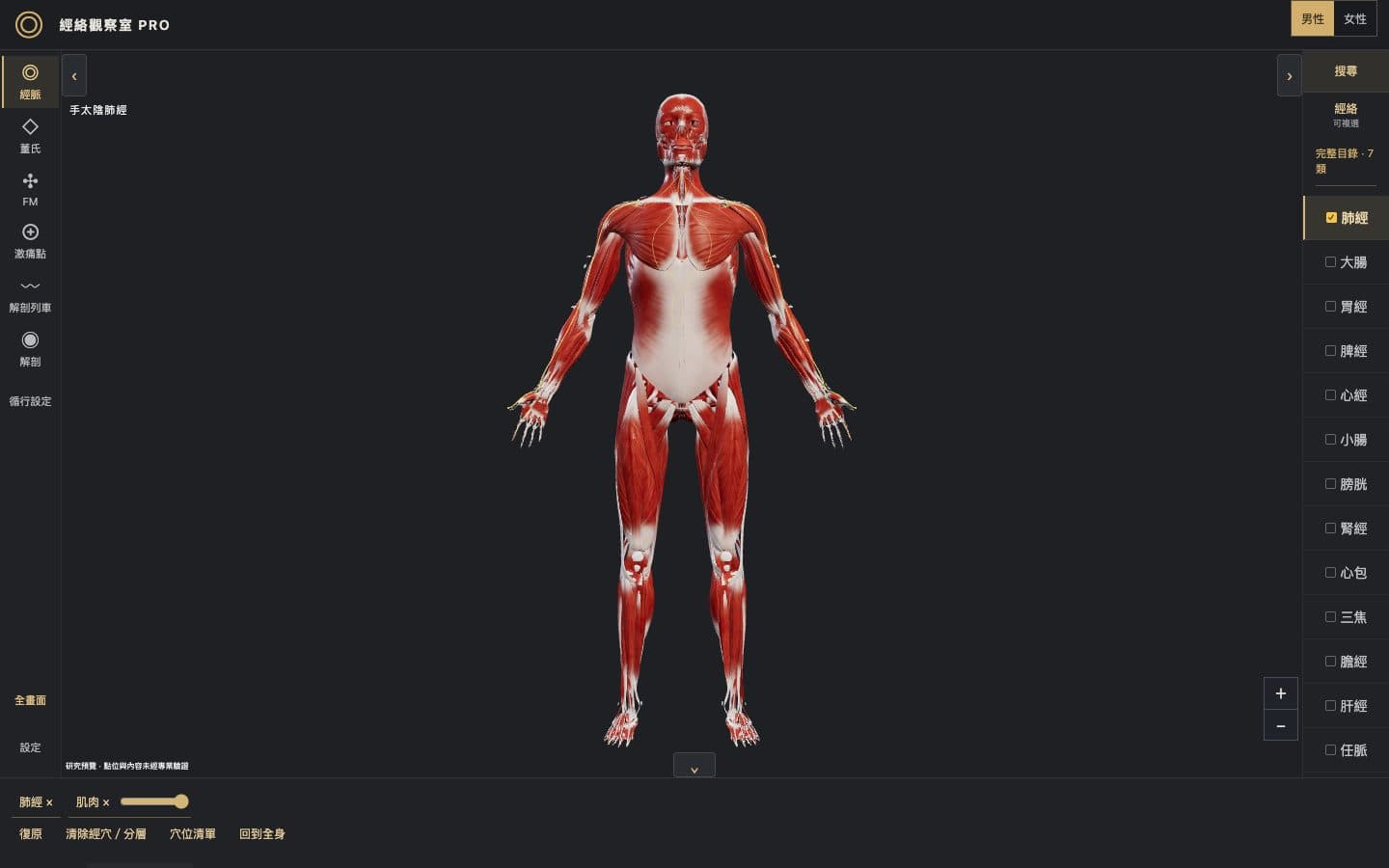
Move between skin, muscle and bone and adjust transparency to understand spatial relationships.
Other tissue layers depend on what the model provides.
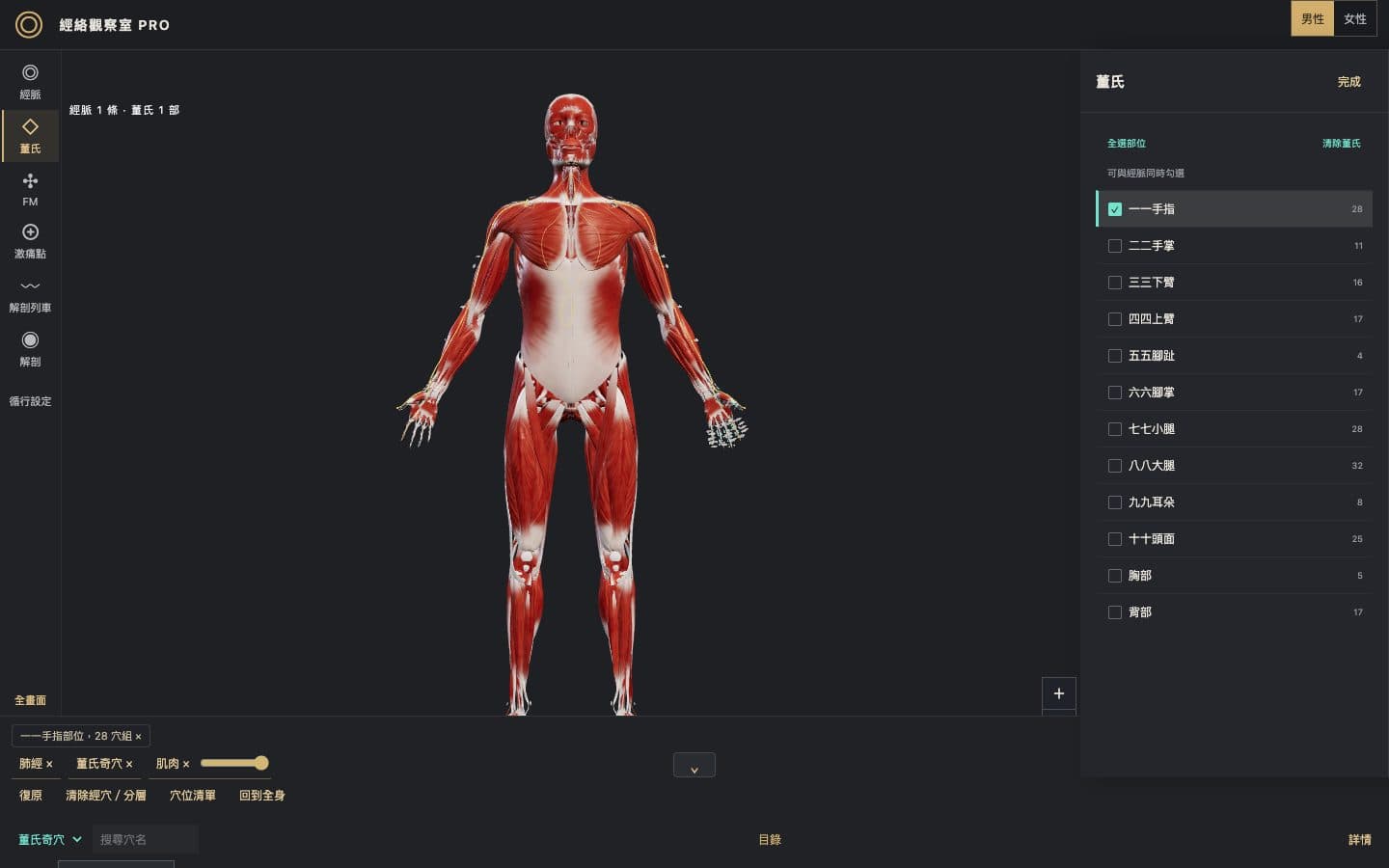
Find point groups by twelve regions — fingers, palm, forearm, upper arm, toes, sole, lower leg, thigh, ear, head and face, chest, back — and compare them with the regular meridians.
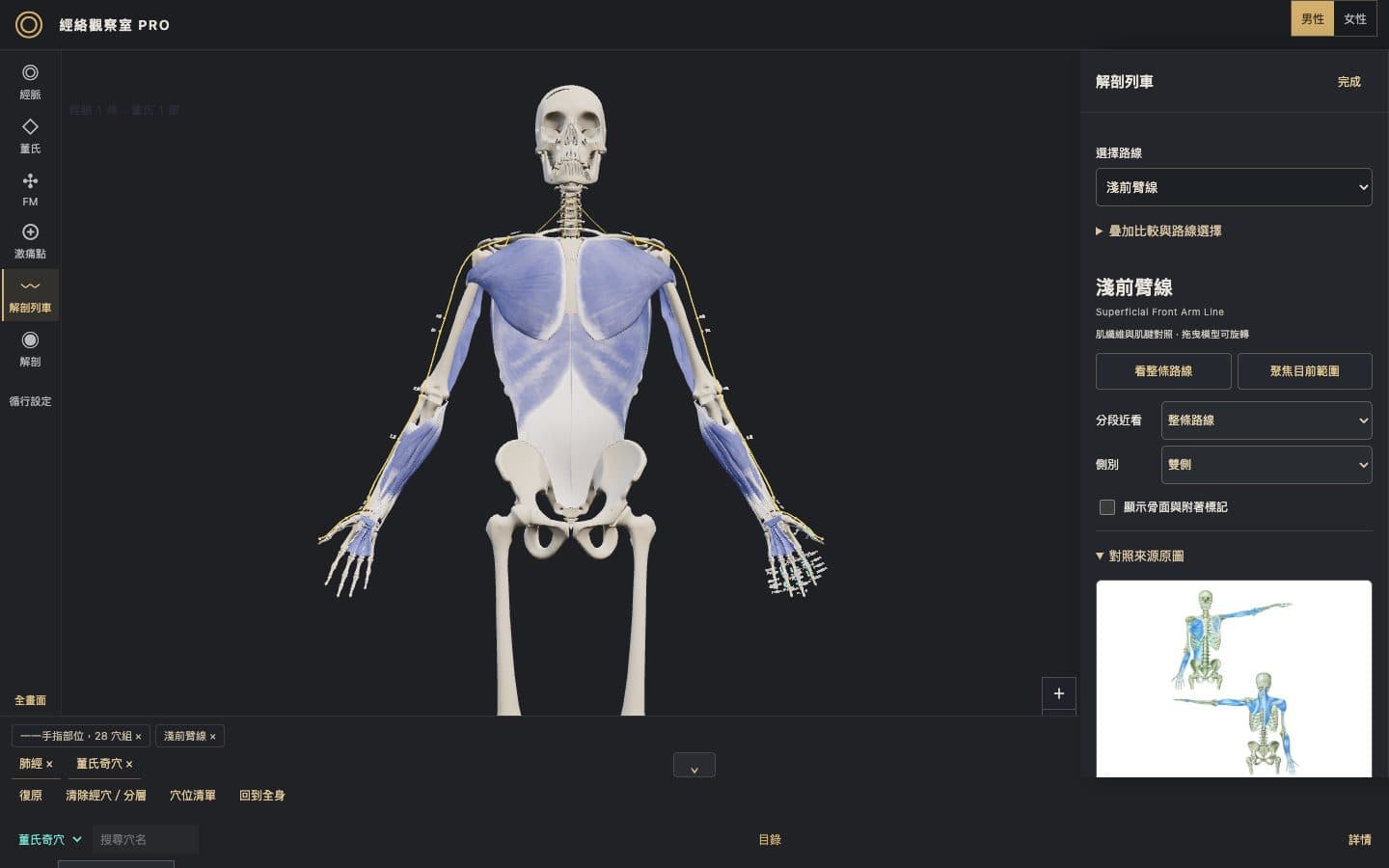
Twelve Anatomy Trains lines: whole line, segment close-ups, side selection, compared with muscles, bony stations, tendons and the source plates. Blue muscle and white tendon is its visual language.
Missing parts are teaching reconstructions and are labelled.
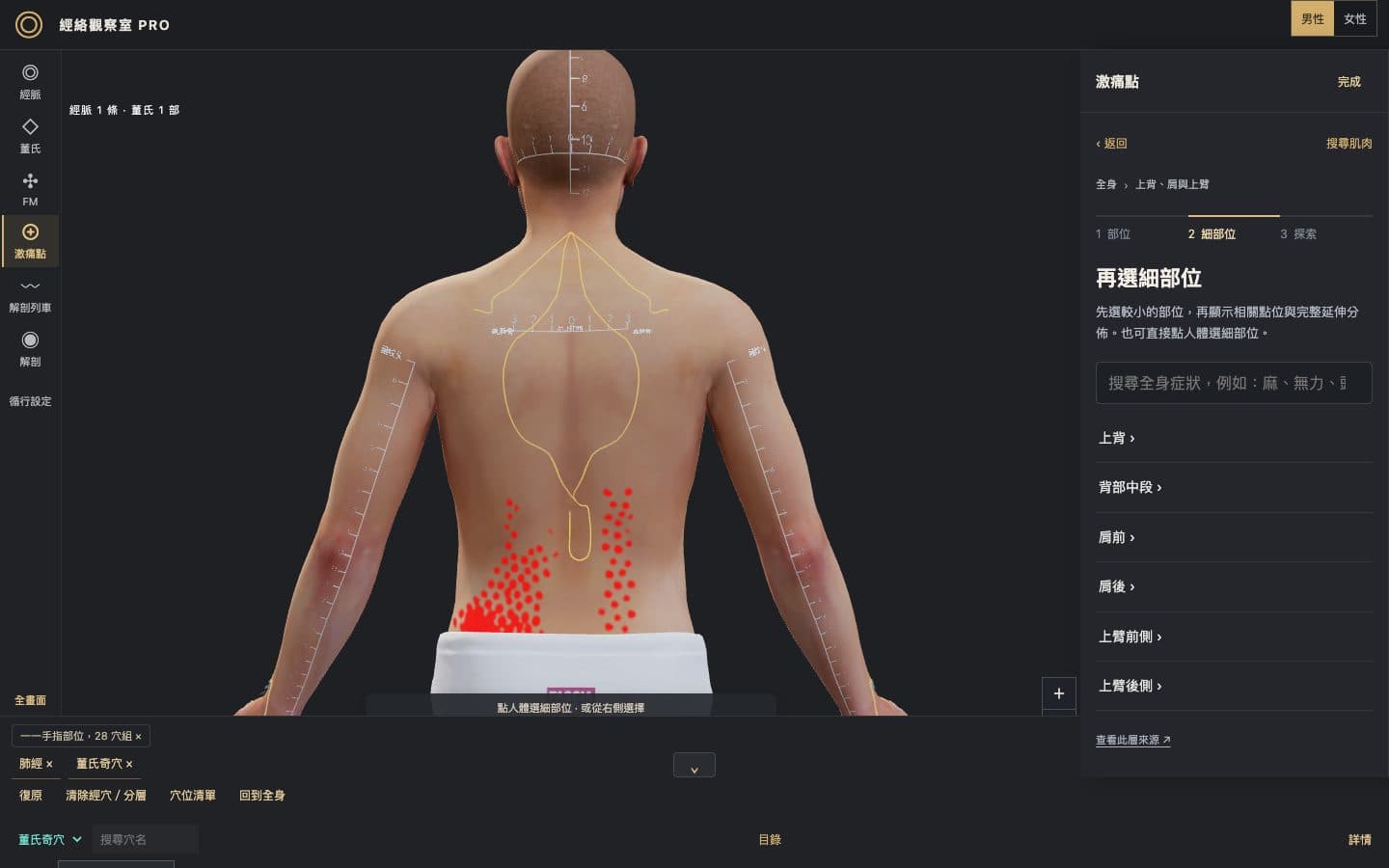
Find related muscles from a pain location or symptom, show trigger-point markers and red referred-pain sketches, then check the source figure.
Red areas are distribution sketches, not proven pathways; a related muscle is not a cause.
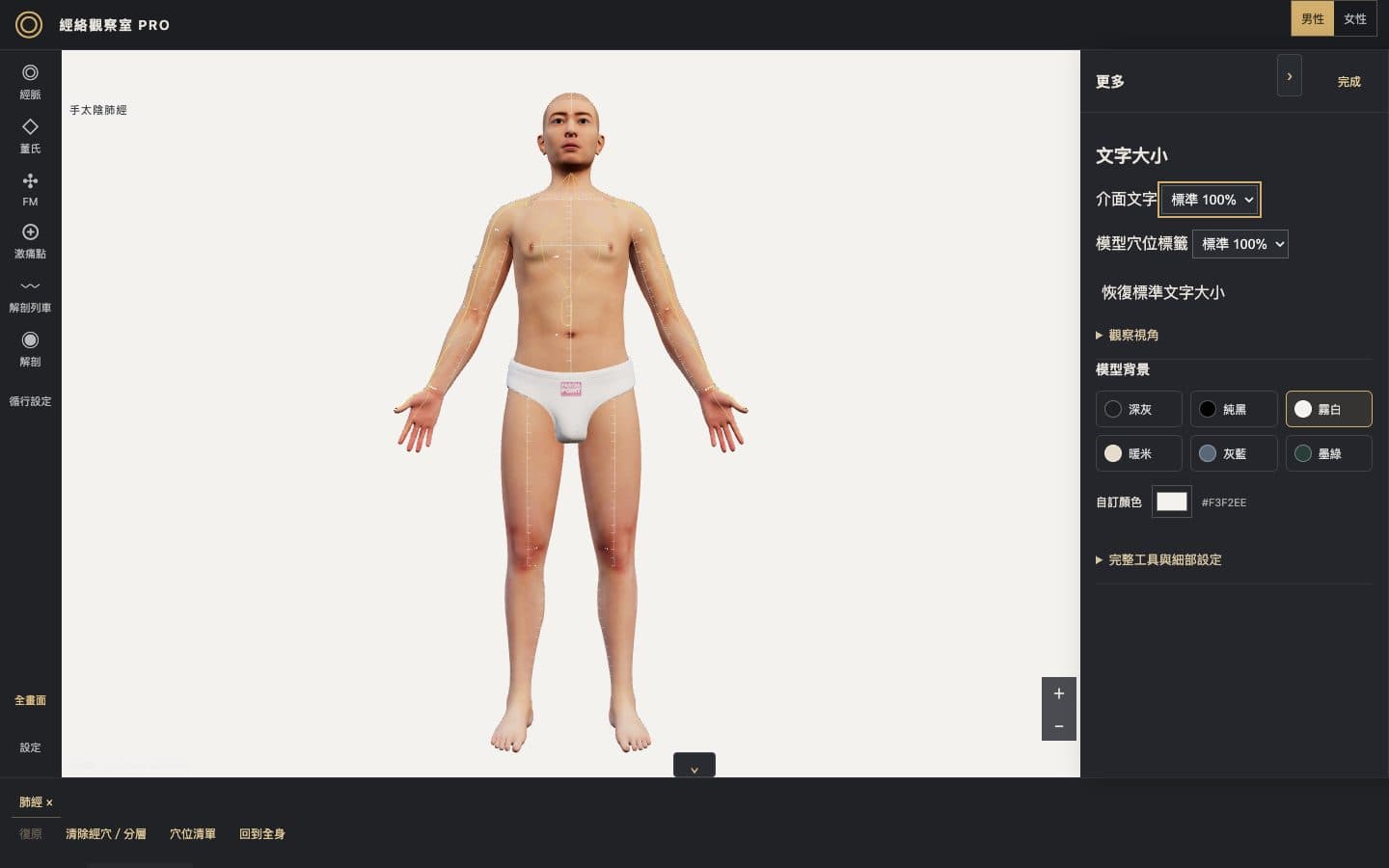
Switch backgrounds (dark grey, black, mist white, warm beige, grey blue, ink green or custom), enlarge interface text and model labels, and go full screen.
Regular meridians, extraordinary vessels, extra points, plus divergent, sinew, cutaneous and collateral categories; coverage depends on the available models.
Twelve regions and 208 point-group names; group count is not the number of points on the model.
An observation module for fascia-related points and lines.
111 catalogue groups, 434 illustrative markers, none professionally verified yet; source figures can be enlarged offline.
Twelve fascial lines with bony stations and reconstructed tendons, compared with Anatomy Trains.
Skin, muscle, bone and other layers with transparency and focus; male and female models, with fewer anatomy assets for the female model.
Breathe in MUNI Scent and let the body slow down; put on the Fascia Point patch and notice where the body is felt; look at the structures around that place in the Observatory; then do a familiar movement and note what changed.